Is it safe to use a regular vacuum cleaner to clean up ashes?
An ordinary household vacuum cleaner is not designed to handle ashes, but there are solutions available to safely and effectively remove ashes.
If you connect a dust collector, it can also be used as an ash extractor. But is that enough?
Here, we will discuss two common solutions and guide you on how to quickly clean your pellet stove, chip boiler, or fireplace with a vacuum cleaner.
Connect a dust collector.
There are several dust collectors in the market that function in a similar way. They generally cost 40-150€ depending on whether it is a dust collector or a vacuum machine specialising in ash handling.
However, these solutions rely on filters, which can become clogged and require frequent cleaning or replacement. Even with sporadic use, it’s important to keep a close eye on the filters.
Cleaning the filter can be a messy task as the ash you want to dispose of can spread into the air, settle on furniture and floors, or even get into your lungs. It is recommended to clean the filter outside to avoid these issues. If you have a lot of ash to vacuum, you may need to clean the filter more than once per session.
Vacuum ash with a cyclone dust separator
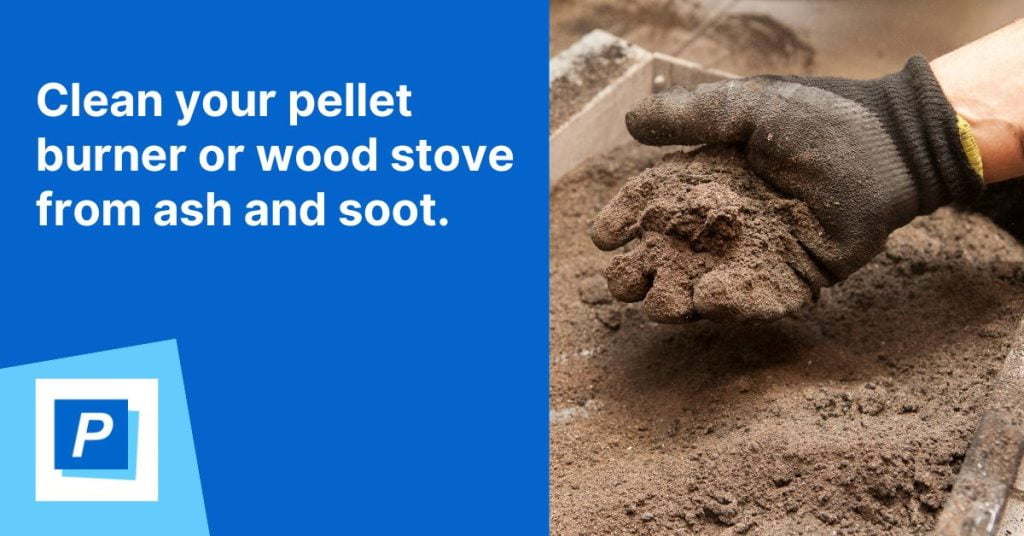
If you use wood, wood chips, or pellets as fuel, it’s necessary to clean up the resulting ash and soot. All users of wood pellet stoves and boilers are familiar with the tedious task of repeatedly vacuuming ash. But what is the best way to clean your pellet stove or fireplace without damaging your vacuum cleaner?
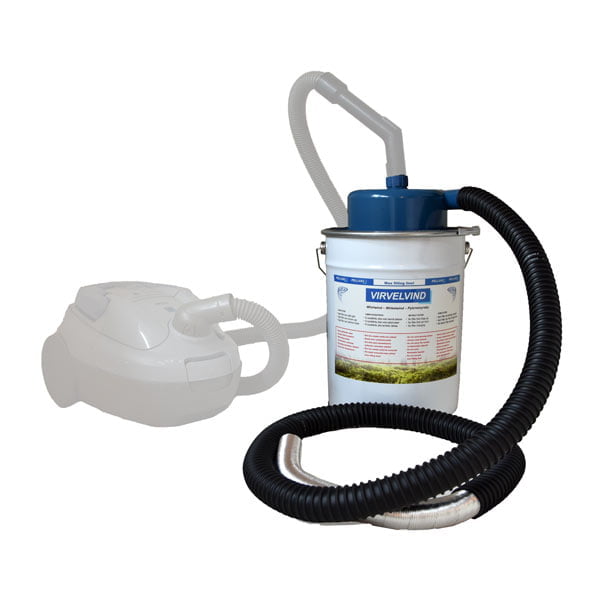
With a cyclone dust collector, you can filter out ash, soot, and other debris before it enters the vacuum cleaner. Introducing the Whirlwind from Pellvac – a smart solution to all your dust and ash cleaning problems! This unique cyclone dust collector connects seamlessly with your regular vacuum cleaner, making it both safe and effortless to clean pellet stoves and fireplaces or just tidy up your workshop from wood dust.
To ensure optimal function of Whirlwind, ensure the vacuum cleaner bag is not full and replace the HEPA filter once or twice a year according to the manufacturer’s recommendation.
Cyclone dust collector
with up to 99% separation efficiency
A Whirlwind dust collector can efficiently collect up to 99% of ash and dust, making it an excellent option for dust collection. For example, pellet ash, soot and sawdust.
Our measurements indicate that Whirlwind can handle particle sizes as small as 5µm.
This opens up many possibilities. Smokehouses are just one example of many manufacturers that have applied the Pellvac dust collector cyclone.
Cyclone dust collector
with up to 99% separation efficiency
A Whirlwind dust collector can efficiently collect up to 99% of ash and dust, making it an excellent option for dust collection. For example, pellet ash, soot and sawdust.
Our measurements indicate that Whirlwind can handle particle sizes as small as 5µm.
This opens up many possibilities. Smokehouses are just one example of many manufacturers that have applied the Pellvac dust collector cyclone.
Is it safe to vacuum
the ash produced by firewood stoves?
When it comes to charcoal left from firewood, there are different factors to consider compared to pellet ash, which is very fine.
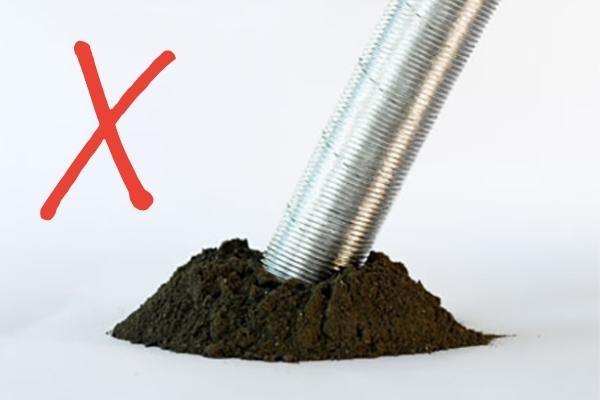
Firewood typically produces both small ash particles and larger coal pieces as byproducts. If charcoal becomes lodged in the hose, it can obstruct airflow and reduce separation efficiency.
If you want to maximize the efficiency, avoid large pieces of charcoal that may clog the hose. If you hear your vacuum cleaner’s pitch increase, try shaking the hose until you hear a rattle in the bucket.
By the way, those large charcoal pieces are great for fueling your next fire, so it’s best to leave them for later.
It is crucial to avoid using any ash vacuum when there are glowing embers among the ash and charcoal. Hot ashes should always be handled with care. However, the Whirlwind dust collector is specifically designed to handle hot ashes! But please note that glowing embers should still be avoided.
Vacuuming the ash from pellets and wood chips.
The Whirlwind cyclone is most effective when used on ash from wood chips and pellets since it is much finer, eliminating any clogging of the hose. Cleaning your pellet stove or boiler can be done quickly and efficiently using a vacuum cleaner connected to the Whirlwind dust collector as
up to 99% of the ash ends up in the bin.
What happens if more than 1% ash enters the vacuum cleaner? Can it be damaged?
Vacuum ashes the right way - Checklist
The Whirlwind dust collector makes it easy to vacuum ash and soot. If you are not achieving the desired removal rate of up to 99%, there are a few factors to take into consideration.
Here’s our checklist. You can also read more here!
Gently does it! Let there be a steady flow of air at all times. Apply 50% air and 50% ash.
Avoid this! To maintain a consistent separation rate, it’s important to avoid being too aggressive with your technique. This can cause fluctuations in airflow, which may lead to a decline in your separation rate.
Please check the power setting of the vacuum cleaner. If the airflow is set too low, it will result in insufficient airflow, causing more ash to enter the vacuum machine. In rare cases, the vacuum cleaner may also have too much suction power. In this case, you need to lower its power as this may overload the integrity of the bucket but also counteract the cyclone effect. Whirlwind works best for airflows between 100-200m3 /h.
FYI! Whirlwind should not be used with bagless vacuum cleaners. A textile bag is crucial in order to collect the 1% ash that will enter the vacuum machine. If not, the ash will quickly clog the HEPA filter.
Check that the vacuum cleaner bag is not full. Next, check your HEPA filter. Most manufacturers recommend changing the HEPA filter 2-3 times a year for normal use. It can be easy to miss a microfilter behind the vacuum cleaner bag. (Applies to some vacuum cleaner models).
How much is
1% ash really?
You can expect to collect about 99% of the ash you vacuum, so if you vacuum 1000 grams of ash, approximately 10 grams should end up in the vacuum cleaner.
Some people may feel that this amount of ash appears excessive and they may worry about damaging the machine. However, it’s important to note that a good vacuum cleaner is designed to capture even the smallest particles of dust. The risk of damage only increases when the filter becomes full, so it’s crucial to ensure that the filter is regularly cleaned and replaced as needed.
If you directly vacuum ash into your vacuum cleaner without using a cyclone separator, it can significantly reduce the lifespan of your machine. Our test showed that after 500 grams of ash, the airflow decreased by 60%, which ultimately caused the vacuum cleaner to stop working soon after.
With a Whirlwind, it’s safe to suck up ash and soot and you reduce the amount of particles that pass through to the Hepafilter.
How much is
1% ash really?
You can expect to collect about 99% of the ash you vacuum, so if you vacuum 1000 grams of ash, approximately 10 grams should end up in the vacuum cleaner.
Some people may feel that this amount of ash appears excessive and they may worry about damaging the machine. However, it’s important to note that a good vacuum cleaner is designed to capture even the smallest particles of dust. The risk of damage only increases when the filter becomes full, so it’s crucial to ensure that the filter is regularly cleaned and replaced as needed.
If you directly vacuum ash into your vacuum cleaner without using a cyclone separator, it can significantly reduce the lifespan of your machine. Our test showed that after 500 grams of ash, the airflow decreased by 60%, which ultimately caused the vacuum cleaner to stop working soon after.
With a Whirlwind, it’s safe to suck up ash and soot and you reduce the amount of particles that pass through to the Hepafilter.